.png)
How do we know life begins when we are conceived?

Updated: Dec 16, 2025
Theologically, Jesus came to earth at conception.
"... Behold, the virgin shall conceive and bear a Son, and shall call His name Immanuel." (Isaiah 7:14, NKJV)
"And behold, you will conceive in your womb and give birth to a son, and you shall name Him Jesus." (Luke 1:31, NAS)
Then Mary said to the angel, “How can this be, since I do not know a man?” And the angel answered and said to her, “The Holy Spirit will come upon you, and the power of the Highest will overshadow you; therefore, also, that Holy One who is to be born will be called the Son of God. (Luke 1:34-35, NKJV)
"And how does this happen to me, that the mother of my Lord* should come to me?"
(Luke 1:43)
Elizabeth was acknowledging that Mary was already a mother, not a mother-to-be, and Jesus in the womb was already her Lord. Jesus was already who he would be while still very recently conceived.
"So all this was done that it might be fulfilled which was spoken by the Lord through the prophet, saying: “Behold, the virgin shall be with child, and bear a Son, and they shall call His name Immanuel,” which is translated, “God with us.” Then Joseph, being aroused from sleep, did as the angel of the Lord commanded him and took to him his wife, and did not know her till she had brought forth her firstborn Son. And he called His name Jesus. (Matthew 1:22-24, NKJV)
And Joseph also went up from Galilee, out of the city of Nazareth, into Judaea, unto the city of David, which is called Bethlehem; (because he was of the house and lineage of David:) To be taxed with Mary his espoused wife, being great with child. And so it was, that, while they were there, the days were accomplished that she should be delivered. And she brought forth her firstborn son, and wrapped him in swaddling clothes, and laid him in a manger; because there was no room for them in the inn. (Luke 2:4-7, KJV)
The Creator stepped from eternity into humanity through conception. God does not distinguish between the child in one's womb from the child in one's arms. And since God cannot lie, His Word is the standard upon which we can know what is true and the standard by which we are called to live.
Scripture tells us the child at six months in the womb can hear and experience emotion.
"For behold, when the sound of your greeting reached my ears, the baby leaped in my womb for joy." (Luke 1:44, NAS)
It is no surprise that everything we discover scientifically points to the truth of Scripture. Scripture that was written three thousand years ago by the Psalmist informs us:
For You formed my inmost being;
You knit me together in my mother’s womb. (Psalm 139:13, BSB)
Only sixty years ago, scientists discovered DNA which is present in our first cell and replicates into every cell of our body. DNA is unique to the individual. Scientists who discovered DNA described it "like knitting".
Scientists recently observed that at the moment a child is conceived, tiny fireworks of light announce the beginning of a new human being. True on multiple levels, Scripture tells us:
"In Him was life, and the life was the light of men." (John 1:4, NKJV)
Scientifically, we know we are living human beings from the moment we are conceived. It is a scientific fact - and 96% of embryologists agree - that we are living human beings from the moment we are conceived. If scientists found our first cell on any planet, they would say they found human life!
Within our first cell is our complete being - nothing will be added to us except oxygen, nutrition, and time - for the rest of our lives. Our first cell begins replicating into every cell of our body until we are hundreds of complex and organized cells implanting into our mother's womb. By 21 days, we have a detectable heartbeat and by 34 days we have detectable brainwaves. A typical pregnancy will end around 40 weeks with the delivery of a living baby, unless the child dies or is delivered early.
Here are the scientific characteristics of what it means to be living:
1) Cellular organization of one or more cells - we have from the moment of our first cell.
2) Metabolism, which is the ability to use energy to carry out the chemical reactions necessary to sustain life - we have from the moment we are conceived.
3) Growth and development according to DNA, resulting in an increase in size and structural complexity over time - we have from the moment we are conceived.
4) Sensitivity to stimuli – the child travels down their mother’s fallopian tube and upon finding the nutrient-rich environment of the mother’s womb, the child implants there and communicates through chemicals to their mother that they are there.
5) Reproduction or the passing of genetic material - our first cell reproduces within 24 hours and continues to grow. We grow most rapidly the younger we are. By the time a little girl is born, she will have already produced all the ovum she will ever produce in her lifetime.
6) All living things increase in size and/or change over a lifetime, which we do from the moment we are conceived.
7) Homeostasis (which literally means, “steady state”): the child regulates their own blood flow and intake of nutrients and oxygen separate from the mother. While the mother’s body heat keeps the child warm, the placenta keeps the blood of the mother and the blood of the child separate, as does the umbilical cord that brings oxygen and nutrition to the child. The child uses the oxygen and nutrition for energy to grow.
The mother’s body knows what to do to bring in more nutrients and oxygen that her child needs. Unless the mother is literally starving to death - at which point a woman is least likely to get pregnant - pregnancy is a healthy part of adulthood, healthy for both her and her baby. A mother’s heart physically grows larger while she is pregnant with a child. And parts of a woman mature that do not mature without pregnancy. There are other benefits to a full-term pregnancy, including another layer of protection against breast cancer, and some studies are beginning to show other health benefits, as well.
Theologically and scientifically, it is an undisputed fact that we are living human beings from the moment we are conceived. It is not the child's humanity in question, but ours. The only question we must answer for ourselves is how will we treat the "least of these" among us? (Matthew 25)
"At that time the disciples came to Jesus, saying, “Who then is greatest in the
kingdom of heaven?”
Then Jesus called a little child to Him, set him in the midst of them, and said,
“Assuredly, I say to you, unless you are converted and become as little children, you
will by no means enter the kingdom of heaven. Therefore whoever humbles himself
as this little child is the greatest in the kingdom of heaven. Whoever receives one
little child like this in My name receives Me.
“But whoever causes one of these little ones who believe in Me to sin, it would be
better for him if a millstone were hung around his neck, and he were drowned in the
depth of the sea. Woe to the world because of offenses! For offenses must come,
but woe to that man by whom the offense comes!
“If your hand or foot causes you to sin, cut it off and cast it from you. It is better for
you to enter into life lame or maimed, rather than having two hands or two feet, to
be cast into the everlasting fire. And if your eye causes you to sin, pluck it out and
cast it from you. It is better for you to enter into life with one eye, rather than having
two eyes, to be cast into hell fire.
“Take heed that you do not despise one of these little ones, for I say to you that in
heaven their angels always see the face of My Father who is in heaven. For the Son
of Man has come to save that which was lost.
“What do you think? If a man has a hundred sheep, and one of them goes astray,
does he not leave the ninety-nine and go to the mountains to seek the one that is
straying? And if he should find it, assuredly, I say to you, he rejoices more over that
sheep than over the ninety-nine that did not go astray. Even so it is not the will of
your Father who is in heaven that one of these little ones should perish."
(Matthew 18:1-14, NKJV)
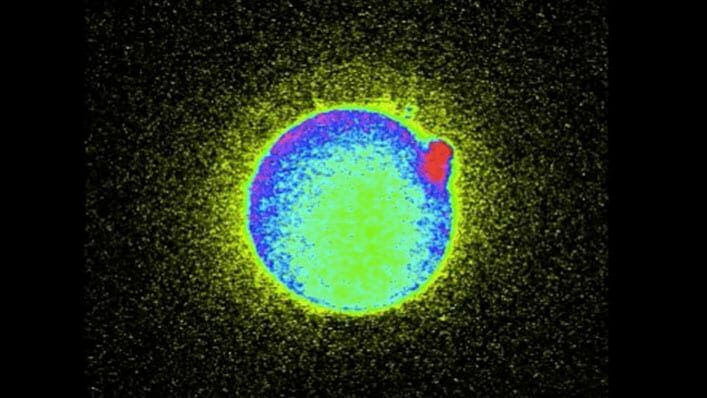
The moment a new living human being is conceived, celebrated by microscopic fireworks of light!


Comments